
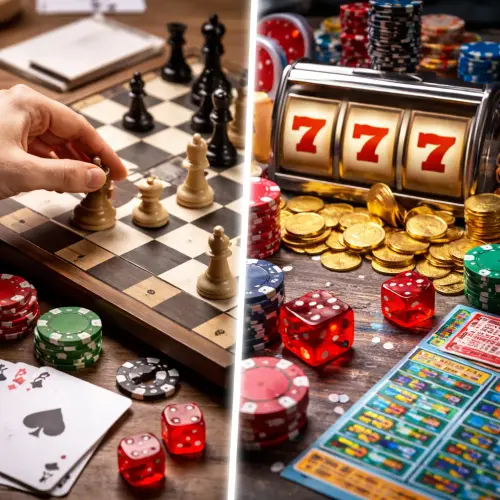

Differences Between Skill-Based Games and Pure Chance Games Key Takeaways
The line between games of skill and games of pure chance is not just academic—it affects how you play, what you can expect to achieve, and even the legal status of the activity.
- Skill-based games reward practice, strategy, and decision-making. Differences Between Skill-Based Games and Pure Chance Games center on player control over outcomes.
- Pure chance games rely entirely on randomness. No amount of preparation can reliably predict or alter the result.
- Your psychology and risk tolerance play a major role in which type suits you best.
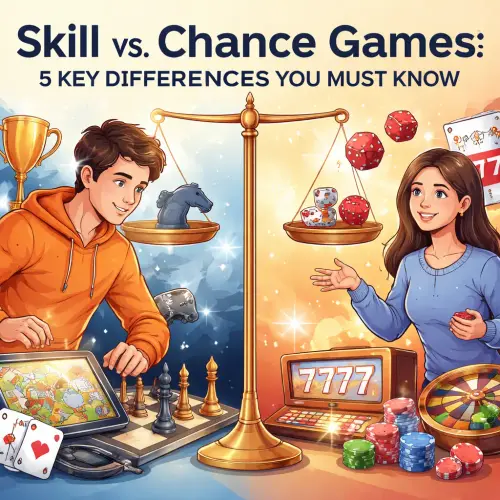
Understanding the Core Differences Between Skill-Based Games and Pure Chance Games
At first glance, many games blend elements of skill and luck. But to grasp the Differences Between Skill-Based Games and Pure Chance Games, you must look at who controls the outcome. In a skill-based game, your decisions, knowledge, and practice directly influence the result. In a pure chance game, each event is independent and random, no matter how experienced you are.
This distinction matters more than you might think. It determines whether you can improve over time, how you should approach the game mentally, and—in some regions—whether the activity is regulated as gambling.
Defining Skill-Based Games
A skill-based game is one where the player’s ability—reflexes, strategy, memory, or knowledge—has a measurable impact on the outcome. The more you practice, the better your results tend to be. Examples include chess, poker, fantasy sports, and blackjack (when played with perfect basic strategy). In these games, a novice will almost always lose to an expert over a meaningful sample size. For a related guide, see 5 Smart Steps to Evaluate an Online Casino’s Safety and Reputation.
Defining Pure Chance Games
A pure chance game is one where the result is determined by random mechanisms such as dice rolls, spinning reels, or shuffled cards. No player choice alters the odds. Examples include slot machines, roulette, bingo, and lottery tickets. The house edge or prize structure is fixed, and every spin or draw is independent of the last.
Key Difference 1: The Skill vs. Luck Ratio
The most fundamental of the Differences Between Skill-Based Games and Pure Chance Games is the skill-to-luck ratio. This ratio determines how much control you have over your own success.
| Game Type | Skill Contribution | Luck Contribution | Player Influence |
|---|---|---|---|
| Chess | ~100% | ~0% | Complete |
| Poker (Texas Hold’em) | ~75% | ~25% | High |
| Blackjack (basic strategy) | ~50% | ~50% | Moderate |
| Roulette | 0% | 100% | None |
| Slot Machine | 0% | 100% | None |
In skill-based games like chess, the better player wins virtually every time. In games with a mixed ratio like poker, skill dominates over many hands but luck can swing short sessions. Pure chance games leave no room for improvement—you cannot “get better” at roulette.
Key Difference 2: Player Psychology and Emotional Engagement
Another crucial aspect of the Differences Between Skill-Based Games and Pure Chance Games lies in how players feel while playing and after losing.
Psychology in Skill-Based Games
In skill-based games, losses feel like lessons. A poker player can review their hand and find mistakes to fix. A chess player analyzes blunders to improve. This sense of agency creates a growth mindset and often reduces frustration. Players are more likely to attribute wins to their own ability and losses to fixable errors.
Psychology in Pure Chance Games
In pure chance games, players often experience the “gambler’s fallacy”—believing that a string of losses makes a win “due.” There’s no feedback loop for learning. Wins feel lucky but fleeting; losses feel unfair and can trigger chasing behavior. This psychological difference makes pure chance games more prone to problem gambling patterns. For a related guide, see Avoid These 5 Family Risks of Problem Gambling in Singapore.
Key Difference 3: Long-Term Expected Outcomes
When you examine the Differences Between Skill-Based Games and Pure Chance Games over time, the trajectory of results diverges sharply.
In skill-based games, the player who consistently makes optimal decisions can achieve a long-term positive result, or at least minimize losses. A skilled poker player can be a net winner over thousands of hours. A chess grandmaster wins tournaments consistently.
In pure chance games, the house edge (or negative expectation) is baked into the math. Over millions of spins or rolls, the casino always wins. Even a “lucky” player will eventually regress to the mean and lose the mathematical advantage built into the game. No amount of skill can overcome a negative expectation.
Key Difference 4: Regulation and Legal Classification
The Differences Between Skill-Based Games and Pure Chance Games are not just theoretical—they have real legal consequences. Many jurisdictions classify games based on whether skill predominates over chance.
In the United States, for example, games like poker are often considered games of skill, which can exempt them from certain gambling prohibitions. Fantasy sports operators have argued that their games are skill-based to avoid classification as gambling. In contrast, slot machines and lotteries are almost universally regulated as pure chance gambling. For a related guide, see 5 Warning Signs to Avoid an Unsafe Casino Website.
Understanding these legal distinctions can help players navigate what is permissible in their region and how winnings may be taxed.
Key Difference 5: Practice and Improvement Potential
Finally, one of the most practical Differences Between Skill-Based Games and Pure Chance Games is the ability to get better with effort.
Improvement in Skill-Based Games
In chess, dedicated study of openings, tactics, and endgames reliably raises your rating. Poker players can work on hand ranges, bluff frequencies, and bankroll management. Fantasy sports enthusiasts analyze player stats and matchups to gain an edge. The time invested translates into better outcomes.
No Improvement in Pure Chance Games
You cannot practice roulette. The wheel has no memory. A slot machine pays out according to a fixed random number generator, unaffected by your button-pressing speed or timing. Buying more lottery tickets increases your probability but not your skill—it’s just more chances at the same fixed odds.
How to Choose the Right Game for You
Now that you understand the Differences Between Skill-Based Games and Pure Chance Games, consider your own goals. If you enjoy mental challenge, enjoy learning, and want control over your success, skill-based games like poker, chess, or blackjack alignment with your personality. If you play purely for entertainment, have no interest in studying strategy, and want fast, low-effort excitement, pure chance games like slots or bingo may suit you.
Always set a budget and time limit, regardless of which type you choose. For more guidance, organizations like National Council on Problem Gambling offer excellent resources on responsible play.
Useful Resources
To deepen your understanding of the Differences Between Skill-Based Games and Pure Chance Games, explore these external references:
- American Gaming Association: Overview of Games of Skill and Chance — A clear breakdown of legal definitions and game classifications.
- ScienceDaily: Game of Skill Definition — A scientific perspective on how skill and chance are measured in various games.
This article was written to help you understand the Differences Between Skill-Based Games and Pure Chance Games and make informed choices. Always play responsibly.
Frequently Asked Questions About Differences Between Skill-Based Games and Pure Chance Games
What is the main difference between skill-based games and pure chance games ?
The main difference is control: skill-based games let your decisions affect the outcome, while pure chance games rely entirely on randomness.
Can a pure chance game ever become skill-based?
No, by definition a pure chance game has no element of skill. However, some games (like blackjack or video poker) have both skill and luck components, but the chance element remains substantial.
Which game has the highest skill-to-luck ratio?
Chess is considered nearly 100% skill with virtually no luck involved, making it the best example of a pure skill game.
Is poker a game of skill or chance?
Poker is widely considered a game of skill in the long run, though luck plays a significant role in individual hands or short sessions.
What are the most popular pure chance games ?
Slot machines, roulette, lotteries, bingo, and keno are the most common pure chance games.
What are the most popular skill-based games ?
Chess, poker, blackjack (with strategy), fantasy sports, and many video games like StarCraft or League of Legends are skill-dominant.
Can you win consistently in skill-based games ?
Yes, skilled players can achieve consistent success in skill-based games, especially when competing against weaker opponents.
Can you win consistently in pure chance games ?
No, over the long run the house edge ensures the player loses money. Short-term wins are possible but unpredictable.
Why do players prefer skill-based games ?
Many players enjoy the challenge, sense of improvement, and control that skill-based games offer, as well as the social aspects of competition.
Why do players prefer pure chance games ?
Pure chance games are simple, fast, require no learning curve, and offer the thrill of uncertainty, which many find relaxing or exciting.
Are video games skill-based or chance-based?
Most video games are skill-based, though some include random loot boxes or chance mechanics that introduce an element of luck.
Is blackjack a skill-based game?
Blackjack incorporates both skill and luck. Using basic strategy reduces the house edge, but the random draw of cards introduces substantial chance.
Do professional gamblers play skill-based or chance games?
Professional gamblers almost exclusively play skill-based games like poker or blackjack, where their expertise can overcome the house edge.
How does the house edge work in pure chance games ?
The house edge is a built-in mathematical advantage that ensures the game pays out less than true odds over time, guaranteeing casino profits.
Are there any pure chance games with no house edge?
No, all commercial pure chance games are designed with a house edge. Even lotteries take a percentage before distributing prizes.
What is the gambler’s fallacy?
The gambler’s fallacy is the mistaken belief that past random events affect future outcomes, like thinking a roulette number is “due” after not hitting.
Can you train to get better at roulette?
No, roulette outcomes are completely random. No strategy or practice can improve your chances of winning.
How do I choose between skill-based and pure chance games ?
Consider your goals: if you want control and improvement, choose skill-based games. If you seek simple, fast fun, pure chance games may be better.
Are fantasy sports considered skill-based or chance?
Fantasy sports are legally considered skill-based in many jurisdictions because player success depends on knowledge of statistics and strategy.
What is the best skill-based game for beginners?
Chess is excellent because it’s pure skill, has a huge learning community, and offers endless room for improvement.