

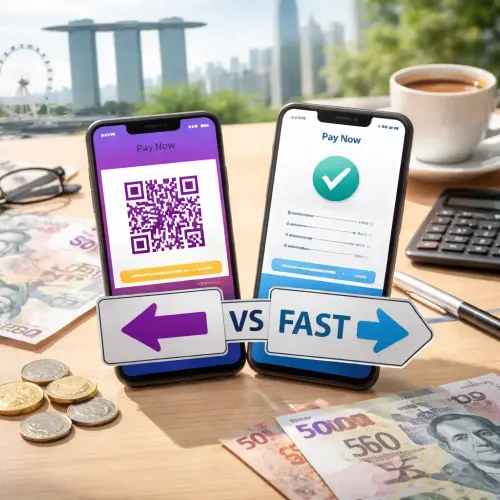

PayNow and FAST Key Takeaways
Singapore’s move toward a digital-first economy has been powered by two key payment rails: PayNow and FAST .
- PayNow and FAST are not competitors — PayNow rides on the FAST network to provide instant, convenient transfers using identifiers like phone numbers.
- Both services are available 24/7, including weekends and public holidays, with most transfers completing in under 30 seconds.
- Knowing the difference between these two systems helps you choose the fastest, cheapest, and most reliable method for paying friends, vendors, and even the government.

Understanding the Core of PayNow and FAST
If you have ever transferred money from your DBS account to someone using only their mobile number, you have used PayNow. But what you may not realise is that the transaction actually moved through the FAST (Fast And Secure Transfers) system behind the scenes. Understanding how these two layers work together is essential for anyone living, working, or doing business in Singapore. For a related guide, see Singapore Pools: 5 Smart Reasons to Choose Legal Betting.
What Is FAST?
FAST is a real-time electronic funds transfer service launched in 2014 by the Association of Banks in Singapore (ABS). It was designed to replace the older GIRO system for urgent payments. With FAST, money moves from one participating bank to another in seconds, rather than taking one or two working days. Over 30 banks in Singapore now support FAST, making it the de facto standard for urgent local transfers.
What Is PayNow?
PayNow is a peer-to-peer funds transfer service launched in 2017. It was created to remove friction from the transfer process. Instead of asking someone for their bank account number and bank code, you simply ask for their NRIC, FIN, or mobile number. PayNow links that identifier to their bank account, so you can send money instantly without error-prone manual entry.
5 Key Differences Between PayNow and FAST
While both services enable instant transfers, they differ in how you initiate a payment, the limits imposed, and the level of convenience provided. Here are the five most important distinctions.
1. How You Identify the Recipient
With FAST, you need the recipient’s full bank account number and bank code. This means you must either memorise or copy the information carefully. One wrong digit can send money to the wrong account. PayNow eliminates this problem by letting you register your mobile number or NRIC/FIN with your bank. You send money by selecting the recipient from your phone contacts or entering their registered identifier. This drastically reduces human error.
2. Adoption by Businesses and Government Agencies
FAST is primarily used for individual bank-to-bank transfers. PayNow, on the other hand, has been adopted by over 200,000 businesses and all major government agencies in Singapore. You can pay your income tax, HDB service charges, and even school fees using PayNow. The government’s PayNow Corporate service makes it easy for businesses to receive payments from customers without sharing bank details.
3. Transaction Limits
FAST transactions can go up to a limit set by your bank, often SGD 200,000 or more per transaction for high-net-worth clients. PayNow typically has lower per-transaction limits, usually ranging from SGD 50,000 to SGD 100,000 depending on the bank. If you need to send a large sum, FAST via bank transfer is usually your better option.
4. Ease of Use for Recurring Payments
FAST does not natively support recurring payment scheduling. You must manually initiate each transfer. PayNow, combined with the PayNow Recurring Payment feature (available in some bank apps), allows you to set up monthly bills such as rent or insurance premiums using just a phone number. This is particularly useful for landlords and tenants.
5. Cross-Border Capabilities
Both services are strictly domestic — they only work between Singapore bank accounts. However, PayNow has a cross-border pilot called PayNow-NETSPay, linking Singapore to India and Thailand for small-value transfers. FAST has no cross-border equivalent. For international transfers, you still rely on SWIFT or other remittance services.
| Feature | PayNow | FAST |
|---|---|---|
| Recipient identifier | Mobile number, NRIC/FIN, VPA | Bank account + branch code |
| Typical limit | SGD 50,000 – 100,000 | SGD 200,000+ |
| Business adoption | Very high (200k+ businesses) | Low (direct bank transfers only) |
| Recurring payments | Supported by some banks | Not supported |
| Cross-border capability | Pilot with India and Thailand | None |
How to Use PayNow and FAST Step by Step
Using either service is straightforward via your mobile banking app or internet banking portal. Follow these steps to get started.
Step 1: Register for PayNow
Open your bank’s app, navigate to the PayNow section, and register your mobile number or NRIC/FIN. Your bank will send a one-time password (OTP) for verification. Once confirmed, you can start receiving money immediately. You can also deregister and re-register if you change banks.
Step 2: Initiate a FAST Transfer
To send money via FAST, log in to your bank account, select the transfer option, choose “FAST” or “Instant Transfer,” and enter the recipient’s full account number. Confirm the amount before submitting. The money will typically arrive within seconds, though some banks display a 15-minute processing window.
Step 3: Use PayNow for Peer-to-Peer Payments
When paying a friend, open the PayNow option in your banking app. Select from your phone contacts or manually enter their mobile number. Review the name associated with the number (most banks show the partial registered name for verification) and confirm the transfer.
Security Notes for PayNow and FAST
Both services operate under strict banking regulations in Singapore. The Monetary Authority of Singapore (MAS) mandates that all FAST and PayNow transactions must be authenticated via two-factor authentication (2FA). This usually means a combination of a password and an OTP sent to your phone. However, users should remain vigilant. For a related guide, see PAGCOR Licensing: 3 Critical Mistakes Online Operators Must Avoid.
- Phishing risk: Scammers may pose as a friend or business to request payment via PayNow. Always confirm the recipient’s identity through a separate channel before sending.
- Irreversibility: Once a FAST or PayNow transfer is credited, it cannot be reversed. There is no chargeback mechanism like credit cards.
- Account takeover: Protect your banking credentials and never share your OTP with anyone, including bank staff.
Future Trends for PayNow and FAST in Singapore
The e-payment landscape in Singapore continues to evolve. Recent developments point toward greater integration and convenience.
- PayNow with QR: Many banks and merchants now support PayNow using SGQR, a unified QR code standard that can process PayNow, NETS, and even credit card payments from a single scan.
- Higher FAST limits: MAS recently announced plans to increase the base FAST limit to SGD 250,000 per transaction to support high-value property and business transactions.
- Cross-border expansion: The PayNow-NETSPay pilot is expected to expand to more ASEAN countries, making Singapore’s e-payment system a regional standard.
Useful Resources
To learn more about Singapore’s digital payment infrastructure, these official sources offer detailed guidance:
Choosing between PayNow and FAST depends on convenience versus flexibility. For everyday person-to-person transactions, PayNow wins for ease of use. For larger sums or legacy banking needs, FAST direct transfer gives you higher limits and broader control. Both services remain free, instant, and integral to Singapore’s vision of a cashless society.
Frequently Asked Questions About PayNow and FAST
Are PayNow and FAST the same thing?
No. FAST is the real-time transfer infrastructure, while PayNow is a service that uses that infrastructure to let you send money using a phone number or NRIC.
How long does a PayNow transfer take?
Most PayNow transactions are completed within a few seconds, though some banks may process them within 15 minutes.
Can I use PayNow for business payments?
Yes. PayNow Corporate allows businesses to receive instant payments from customers using a unique UEN number or mobile number.
What is the maximum limit for a FAST transfer?
FAST limits vary by bank. Most banks allow up to SGD 200,000 per transaction, and some premium accounts go higher.
Is there a fee for using PayNow?
PayNow is free for individuals. Some banks may charge corporate accounts for certain volumes.
Is FAST transfer free?
Most banks offer FAST transfers for free if done through their digital channels. Counter or phone-based FAST may incur a fee.
Can I send PayNow to someone overseas?
Currently, PayNow is domestic only. A limited cross-border pilot exists between Singapore and India/Thailand.
Can I cancel a FAST transfer after sending?
No. Once the funds are credited, the transfer is final. Contact your bank immediately if you suspect an error.
Do I need a special bank account for PayNow?
No. Any personal current or savings account from a participating bank can be linked to PayNow.
How do I register for PayNow?
Open your banking app, go to the PayNow section, select your identifier (mobile or NRIC), and verify with an OTP.
Can I have multiple bank accounts linked to one PayNow number?
No. Each mobile number or NRIC can only be linked to one bank account at a time.
What happens if I send PayNow to the wrong number?
If the number is not registered, the transfer fails. If it is registered to someone else, the funds are credited and cannot be reversed.
Does PayNow work on weekends?
Yes. PayNow and FAST both operate 24/7, including weekends and public holidays.
What is the difference between PayNow and PayLah?
PayLah is DBS’s own mobile wallet app. PayNow is a nation-wide interoperable standard used by all major banks.
Can I use PayNow to pay at retail stores?
Yes, many retail stores display a PayNow QR code at the counter which you can scan using your banking app.
What is the minimum amount for FAST?
There is no minimum amount. You can send as little as SGD 0.01.
Is PayNow available for foreigners?
Yes. Foreigners can register using their FIN or mobile number as long as they have a local bank account.
Do FAST transfers notify the recipient automatically?
No. FAST transfers reflect in the recipient’s bank balance instantly, but there is no automatic notification unless you inform them separately.
Can I schedule recurring PayNow transfers?
Some banks support recurring PayNow payments. Check with your bank for availability.
Why did my FAST transfer take more than a few seconds?
Delays can occur if the recipient’s bank processes transactions in batches or if your transfer is flagged for security review.